Murmur
Say an idea out loud. Murmur researches the market, writes the PRD, the brand kit and the engineering brief, then builds the Jira board and Confluence space in your own Atlassian account.


One public run, ShipReel, from a 49 s memo. Every screen is a real capture and every number is read from the run file.
Try Murmur (opens in a new tab)Record the idea in the app, up to ten minutes. Press Run. Murmur works through four stages and hands back eight artifacts, and the Jira board and Confluence space are real, in your own Atlassian account.
It is a foundation, not a finished app. It writes the plan and sets up the board; it doesn't write the product's code.
- Status
- Early access
- Opens
- 1 October 2026
- Built
- April to September 2026
- Stack
- Next.js, Supabase, n8n, AssemblyAI, Exa, Claude, Atlassian APIs, Dodo Payments
- Role
- Product, design and engineering. Built with Claude Code.
What comes out of one memo
1 of 6
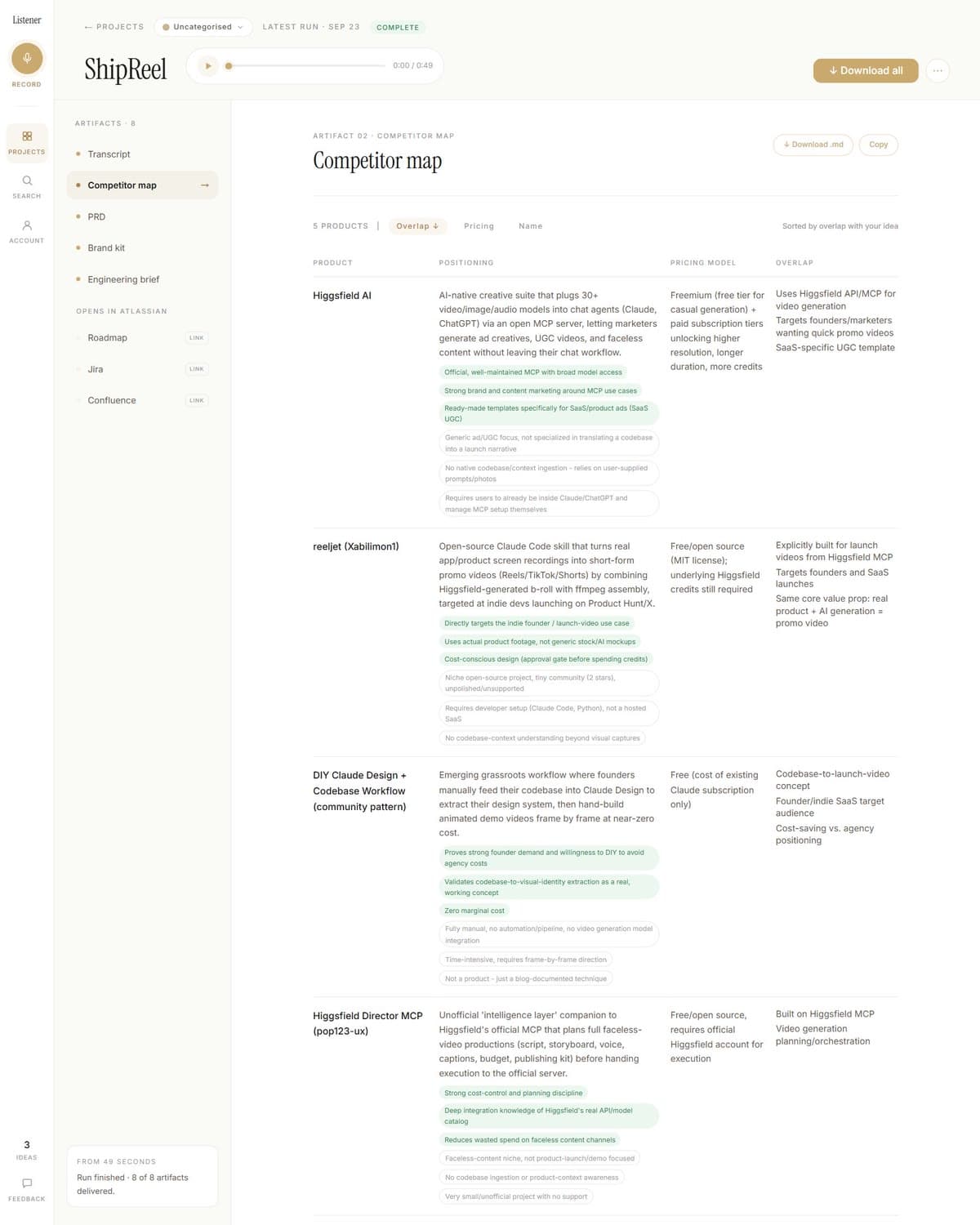
Competitor map
Exa searches the market. Each competitor gets its positioning, pricing model and overlap with the idea. ShipReel's run found 5.
2 of 6
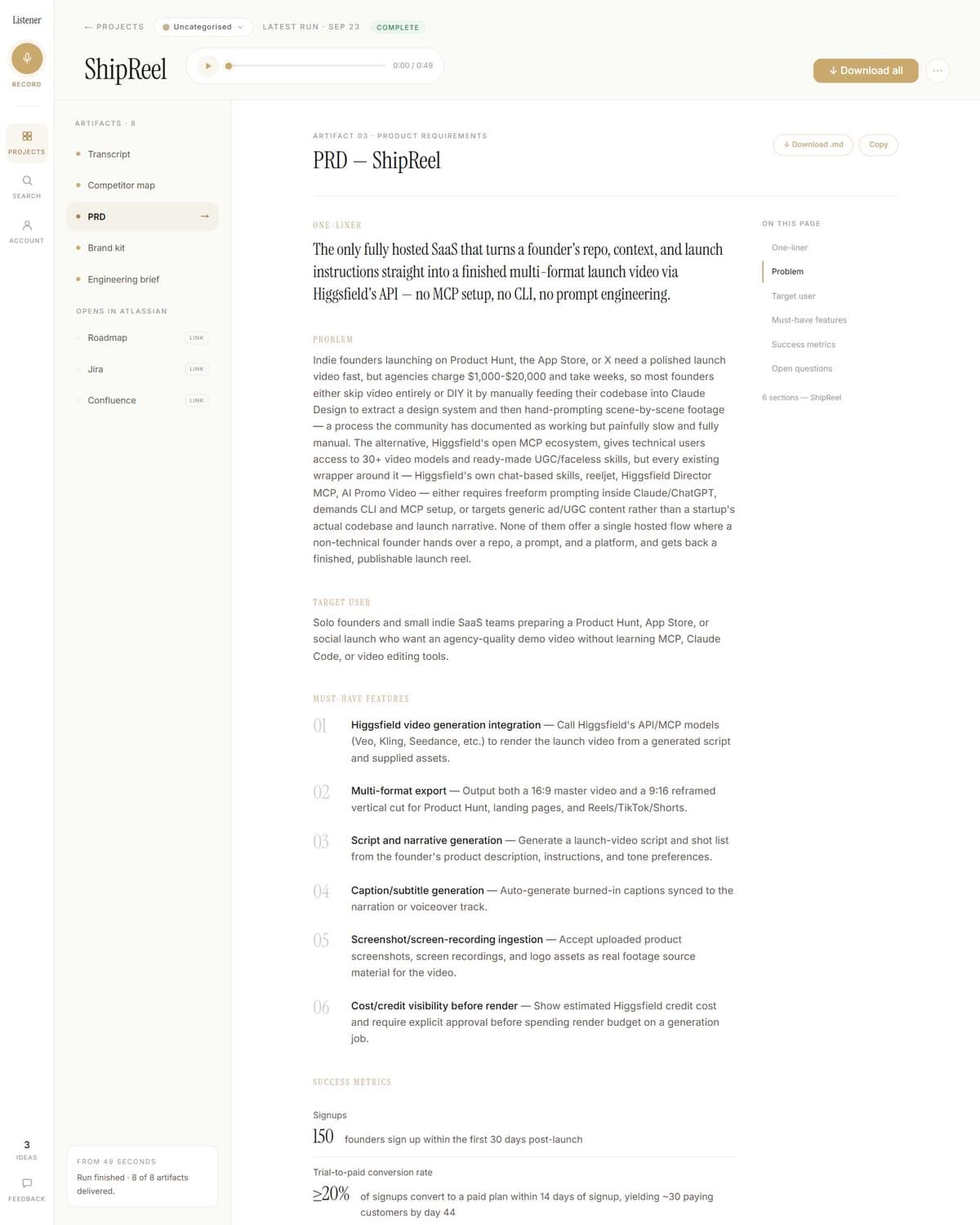
PRD
The problem, the users, success metrics and features sorted must, should, could and won't.
3 of 6
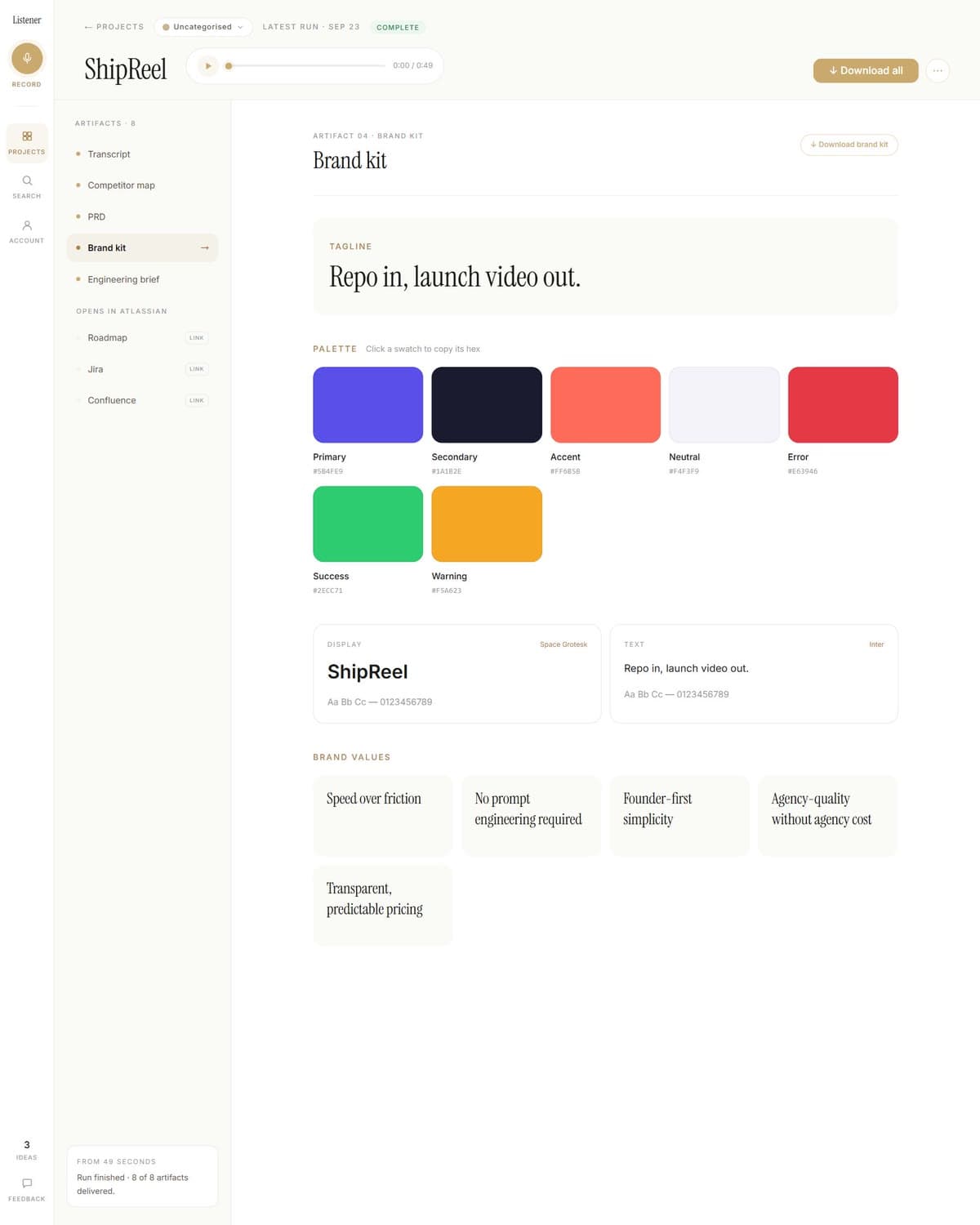
Brand kit
A tagline, a palette with hex values, type and brand values, downloadable as a zip. ShipReel's tagline: “Repo in, launch video out.”
4 of 6
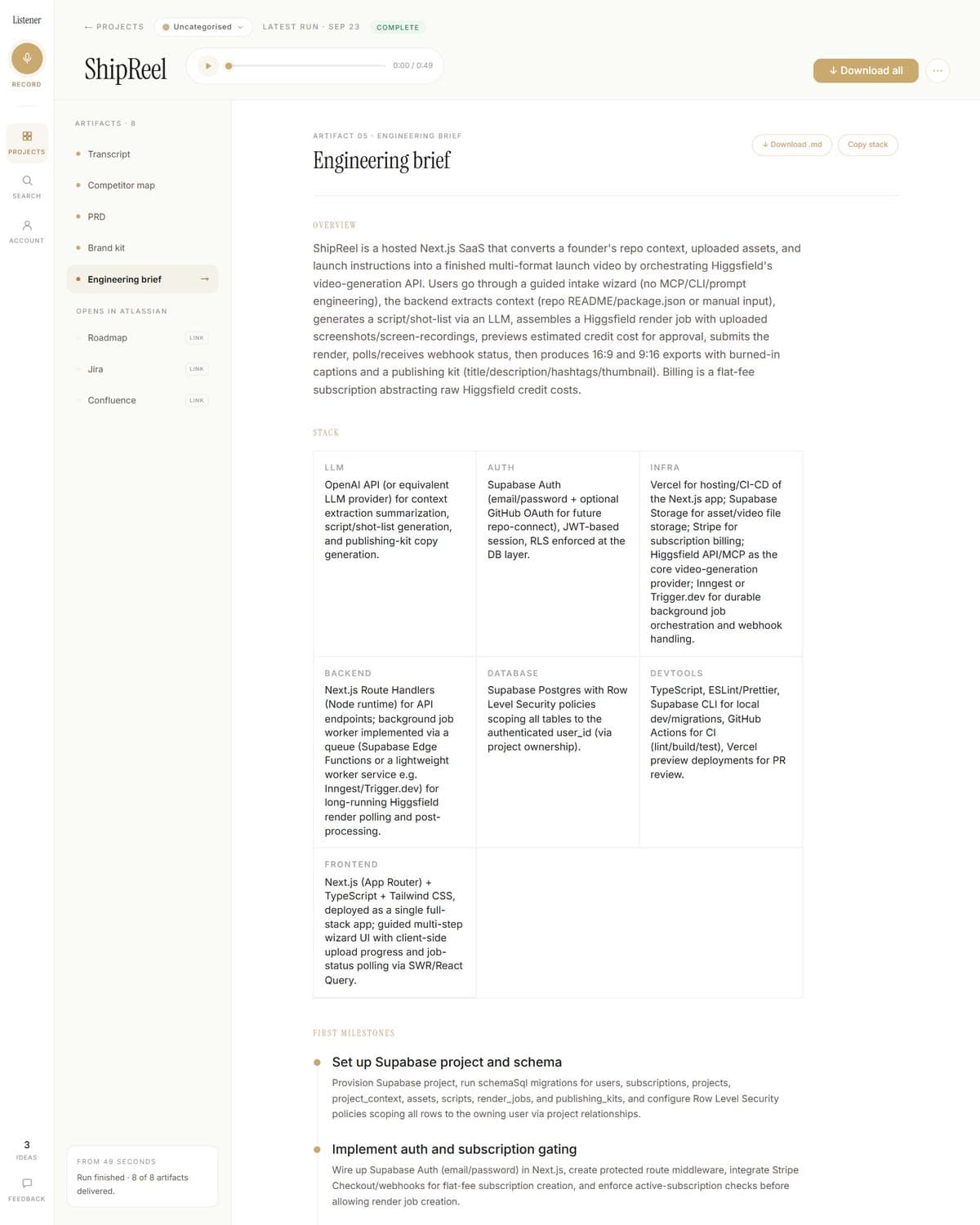
Engineering brief
Architecture, data models, a database schema and the engineering tasks, ready to plan against.
5 of 6
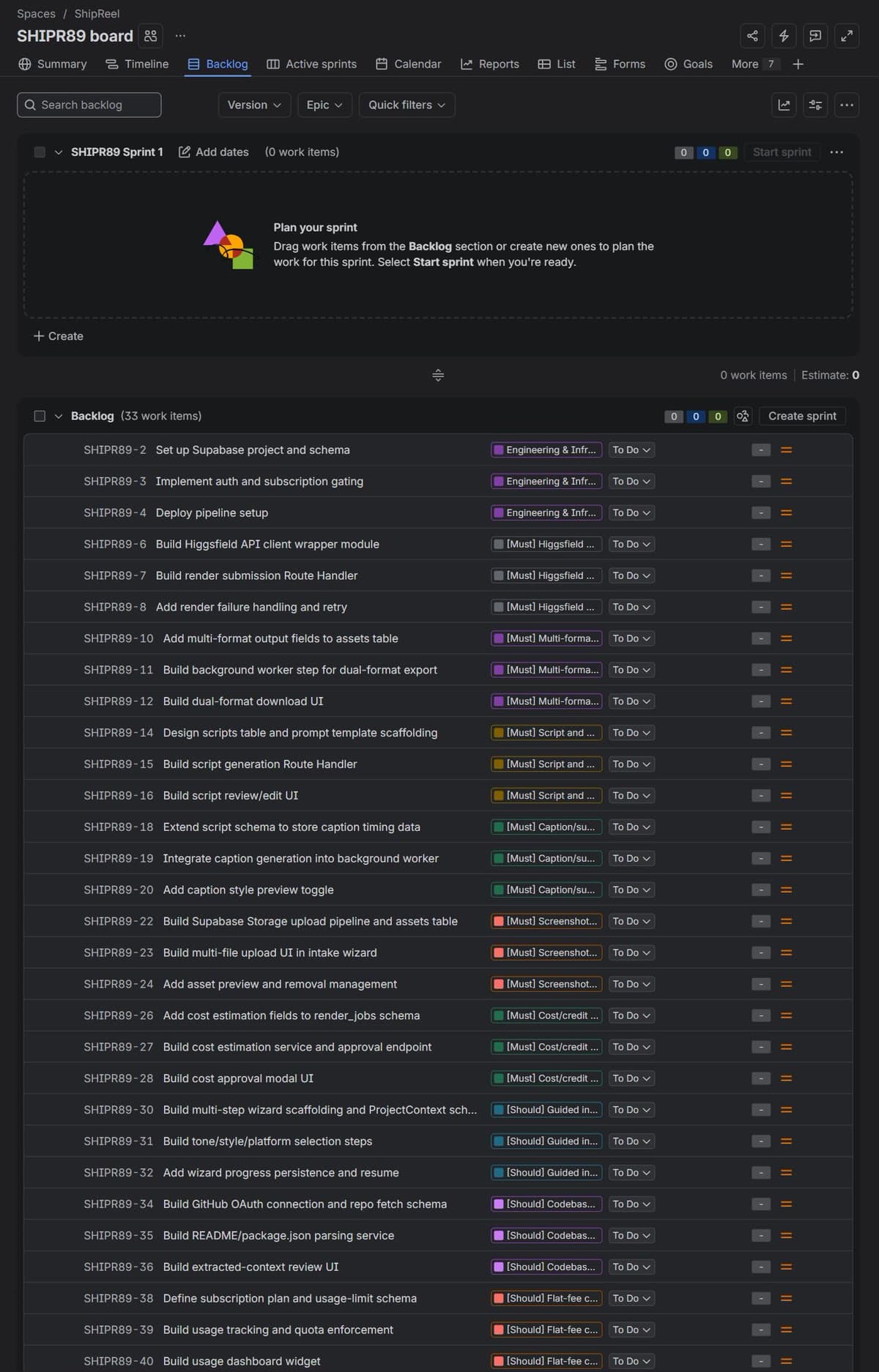
Jira board
Epics and stories created in your Jira through Atlassian's API. ShipReel: 11 epics, 33 stories.
6 of 6
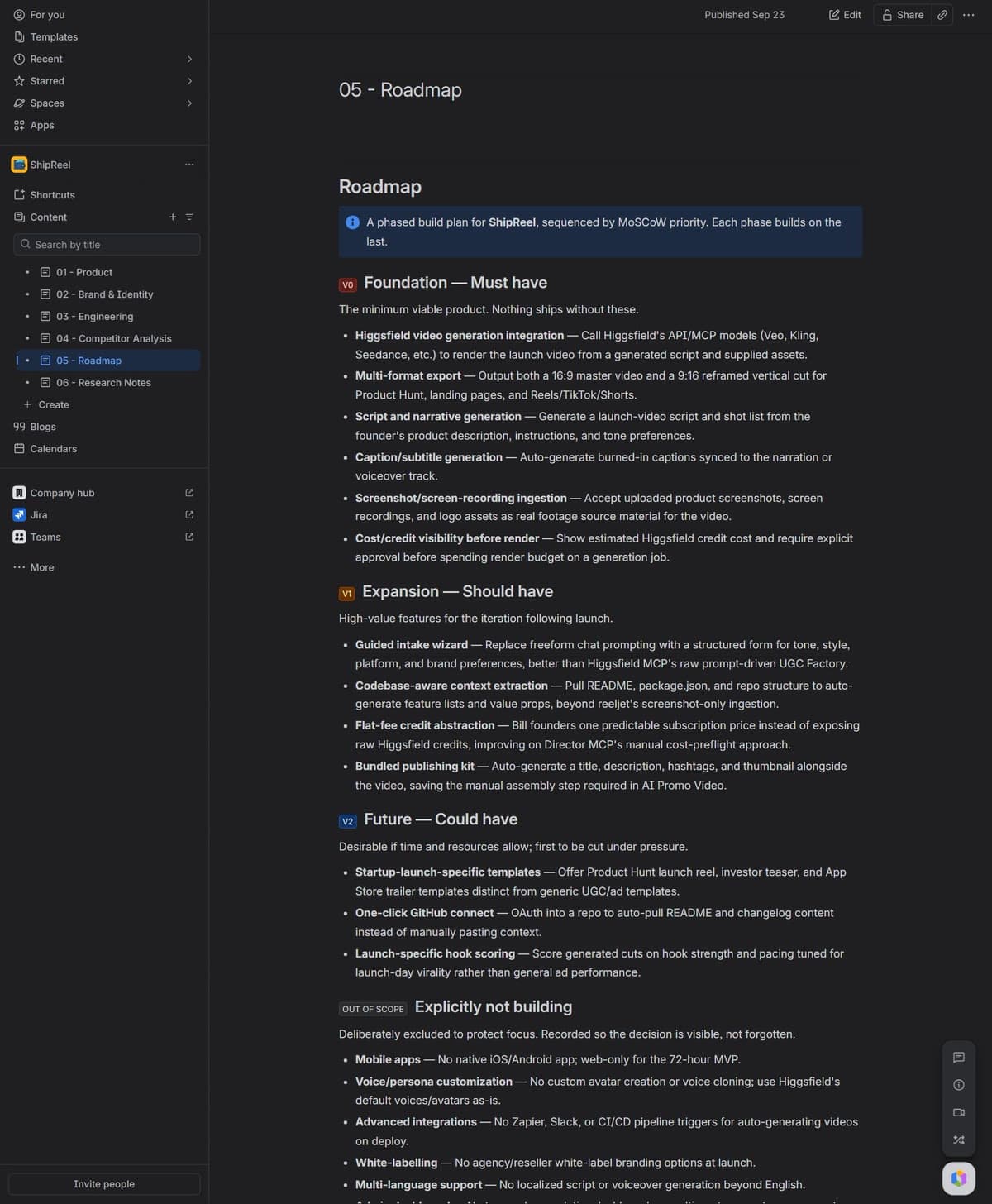
Confluence space
Six pages: Product, Brand and Identity, Engineering, Competitor Analysis, Roadmap and Research Notes.
Real screens from the ShipReel run. ShipReel's competitor map in Murmur: five competitors found from a 49-second memo.
Four public runs, measured
Creature Clash: Duel Loop Prototype
Mobile creature-battler game prototype
- Epics
- 12
- Stories
- 47
- Competitors
- 2
2 m 56 s memo9 m 22 s runShipReel
Launch-video SaaS for founders
- Epics
- 11
- Stories
- 33
- Competitors
- 5
49 s memo7 m 02 s runAavaas
AI home-design & floor-plan tool
- Epics
- 11
- Stories
- 39
- Competitors
- 6
1 m 57 s memo7 m 42 s runFin Matter
Personal AI finance assistant
- Epics
- 11
- Stories
- 41
- Competitors
- 7
2 m 57 s memo7 m 31 s run
Where the time goes
The last stage takes the longest. It writes the engineering brief and the roadmap, then creates every epic, story and Confluence page through Atlassian's API.
This run took 10 m 59 s, longer than any of the four public ones, which is why it's labelled on its own.
- Researching the market90 s
- Writing the PRD111 s
- Designing the brand26 s
- Building your board422 s
How it works
Record
Up to ten minutes in the app, on a phone or a laptop. The memo is transcribed as soon as recording stops.
Next.js app, AssemblyAI
Checks before it runs
A transcript, a connected Atlassian account and enough balance. If the balance check fails, the run doesn't start.
Supabase
A signed handoff
The app sends the audio to the pipeline with a signature over the run, a timestamp and a hash of the audio, so the pipeline only runs what the app sent.
HMAC-SHA256, to the Bridge on n8n
Research
Competitors and the market around the idea.
Exa
PRD, brand kit, engineering brief
Written one stage at a time from the transcript and the research.
Claude
The board
Epics, stories and a six-page Confluence space, created in the user's own account. Access tokens are stored encrypted.
Atlassian OAuth, AES-256-GCM
Live progress
Each stage reports back as it finishes, so the app shows the run moving in real time.
Supabase Realtime
Decisions
Screens captured behind a privacy gate
The screenshots here come from a script, not a human with a screenshot key. It hides account menus, avatars and bylines before the page paints, crops the Atlassian chrome, scans each screen's text for emails, keys and tokens, and drops any screen with a hit.
24 screens from 4 runs
Captured for Murmur's site, each one text-scannedSource: Murmur's capture script and its committed captures A judge that can't inflate a score
Runs are scored by deterministic checks first. An LLM judge can only lower that score, never raise it: the final score is the check score times (0.5 + 0.5 × the judge's rating), so a perfect rating leaves it unchanged.
19 deterministic checks
Across the PRD, research, engineering, Jira, operations and one cross-checkSource: Murmur's quality-judge code Numbers in films are recomputed
Before a Murmur film renders, a guard recomputes every number on screen from the run it shows. If one doesn't match, nothing renders.
A page that doesn't jump
Jumping straight to the run explorer used to shift the whole layout. Replays that swapped content for skeletons were replaced with transforms and colour changes.
0.43 to 0.000
Layout shift on the run explorer, before and afterSource: Murmur commit 7d01139 Fail closed on money
If the balance check itself errors, the run is refused rather than let through. A failed run never uses up an idea.
Tokens encrypted at rest
Atlassian access tokens are encrypted before they're stored and refreshed with rotation a minute before they expire.