Creature Clash
A creature-duelling game for phones: six species, secret picks and gym battles, all decided by one TypeScript engine.
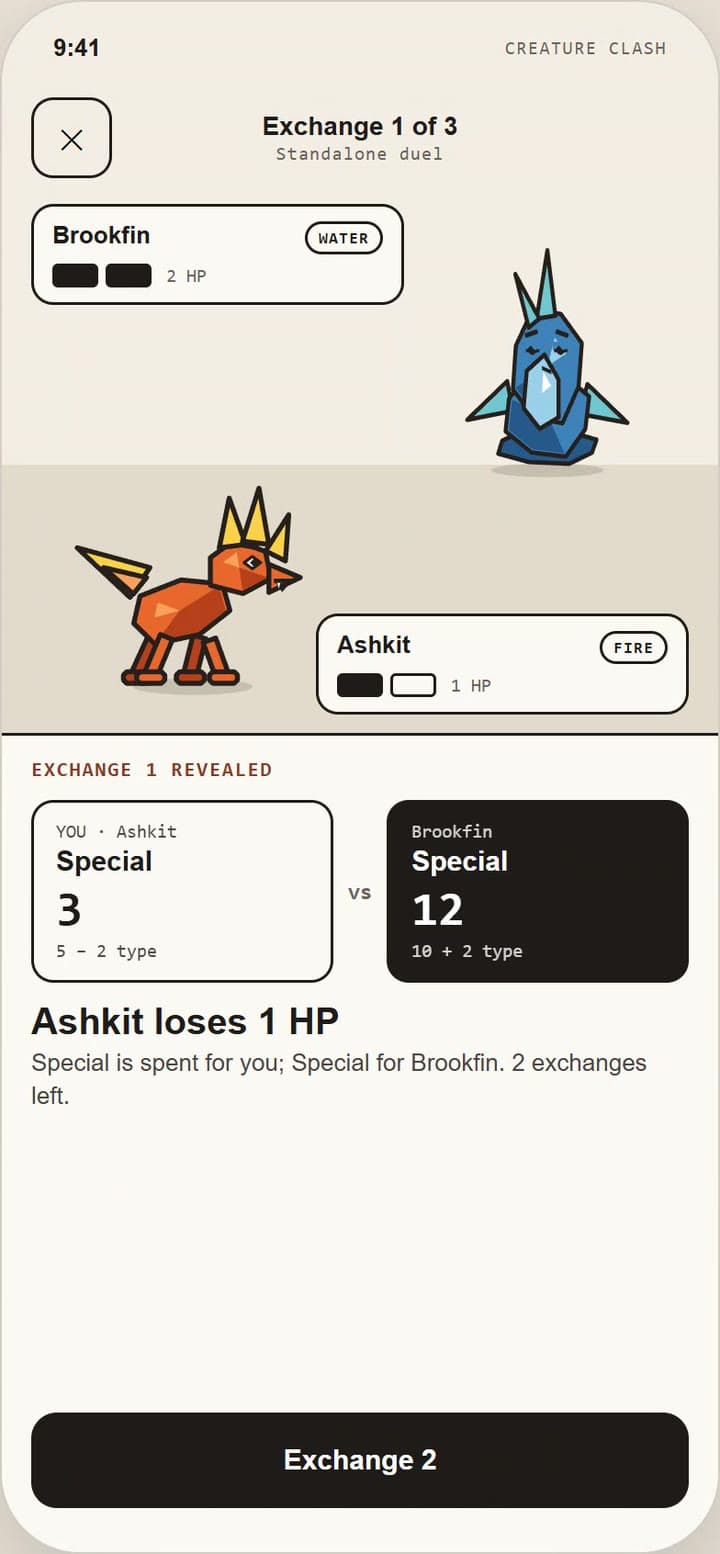 A duel in the Creature Clash design prototype: Ashkit against Brookfin, three exchanges, each side's choice revealed, then Victory.
A duelling game for phones. Each creature has 2 HP and four categories, Attack, Defense, Speed and Special, each used once. Both players pick in secret within ten seconds, the picks are revealed together, and the lower value after type costs 1 HP. Three exchanges, and a fourth if it's still level.
Gym battles raise the stakes: lock three of your six in private, deploy one in secret before each of three duels, and the winner may trade one of its creatures for one of the loser's. Wins earn XP, and levels buy training points.
- Status
- Built
- Runs on
- Android, as a development build. iOS not verified yet; not in a store.
- Built
- 7 to 25 September 2026
- Stack
- Expo SDK 57, React Native 0.86, TypeScript, Skia, NativeWind
- Design
- Claude Design, rebuilt as native screens
- Role
- Product, game modes, interaction, design and engineering. Built with GPT Astra 6.
Six species, three moods each
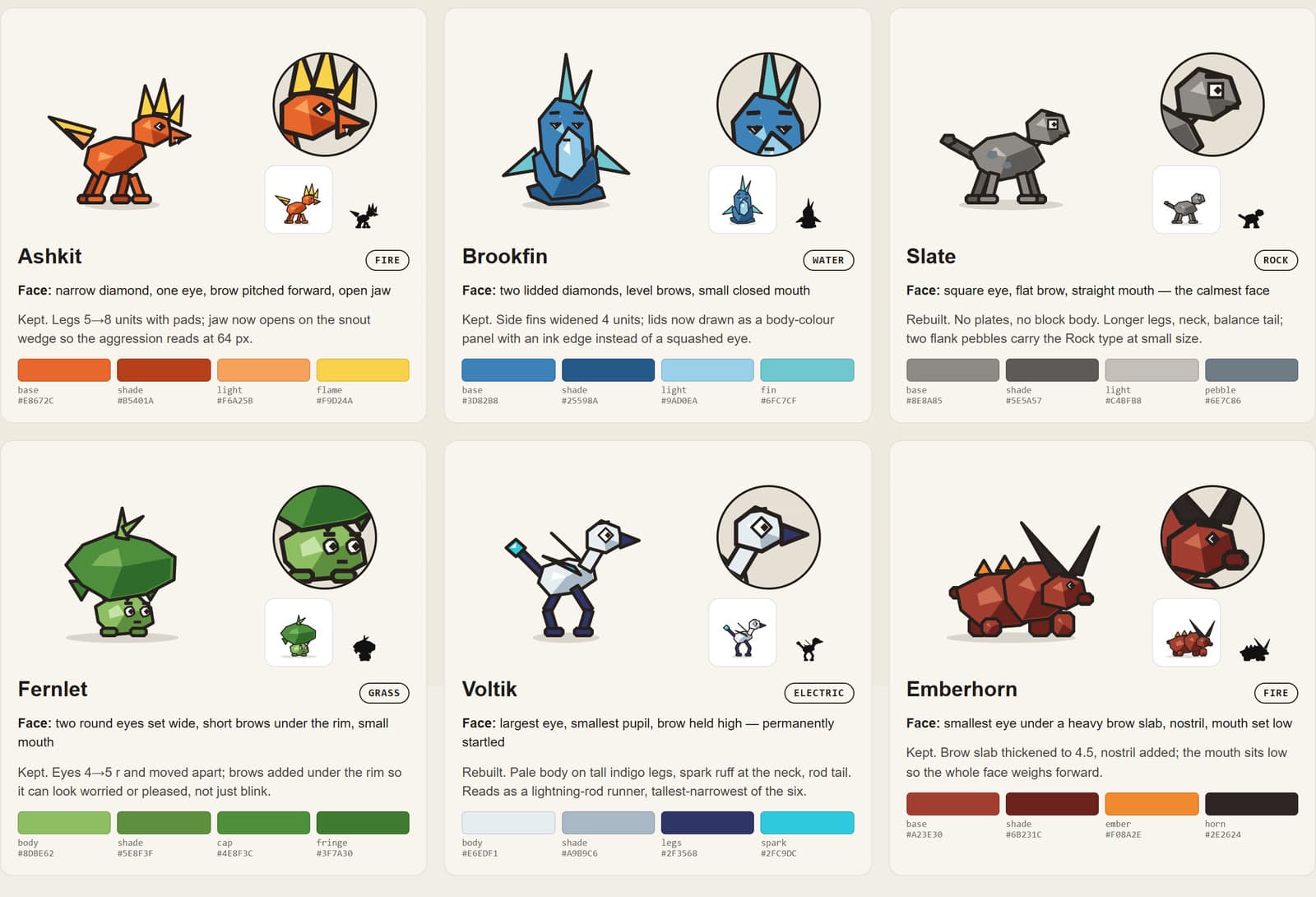
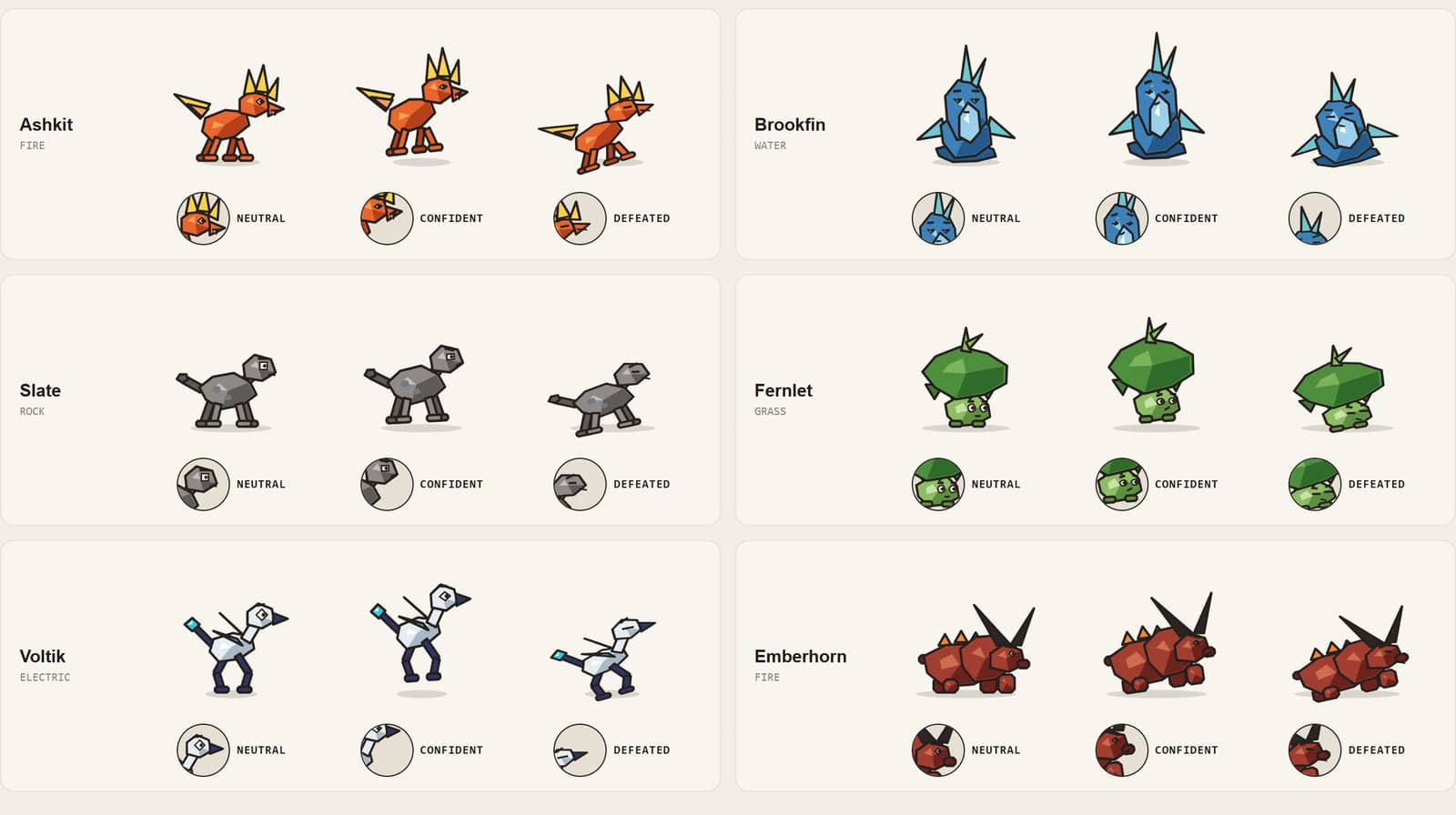
From the Claude Design character sheet in the project's repo. The app draws the same vectors with Skia.
One engine decides every result
The rules live in their own TypeScript package: no React, no Expo, no phone code. The app asks the engine what each side is allowed to see and draws that. No win, score or damage maths lives in the app.
The offline studies below run on the same engine and the app's own AI, so what they measure is the game itself, not a copy of it.
138
18 days
19
Balance, simulated before it's played
The first played 1,600 gyms, both trainers on the same AI, with training and exchanges switched on and off. With both sides on the tactical AI, draws fell to 11 to 22 in 200 gyms, from 47 to 54 with the greedy one.
The second checked training builds across all 36 species pairings, 4,320 build and matchup cases. At the largest budget, 4 of 750 equal-budget matchups left one side with no way to win, all Emberhorn against Fernlet, so that rule is still marked experimental.
These show what can happen, not how often people win. Pacing, readability and whether you want another duel still need people playing on a phone.
| Greedy AI on both sides | |||
|---|---|---|---|
| Setup | A | B | Draws |
| Training off, exchanges off | 79 | 67 | 54 |
| Training off, exchanges on | 90 | 63 | 47 |
| Training on, exchanges off | 80 | 69 | 51 |
| Training on, exchanges on | 88 | 64 | 48 |
| Tactical AI on both sides | |||
| Setup | A | B | Draws |
| Training off, exchanges off | 80 | 98 | 22 |
| Training off, exchanges on | 88 | 100 | 12 |
| Training on, exchanges off | 84 | 97 | 19 |
| Training on, exchanges on | 93 | 96 | 11 |
From first commit to progression in 18 days
The engine came first, then a playable phone screen. The Claude Design work arrived on 19 September and was rebuilt as native components on top of the working game. These times are straight from the git history, in India Standard Time.
- First commit: the Expo app and an empty engine packageeb73c8a · feat: project setup
- The battle engine, in plain TypeScript5f7349b · feat: battle engine init
- Player views: what each side is allowed to see4db91ac · feat: player views
- Sessions, and greedy and random AI7e663c0 · feat: session policies
- The first duel on a phone screen8827fb4 · feat: native screen duel simulation
- Encounters, 3v3 and an offline battle studyc32be75 · feat: encounters, swap run, 3v3
- Gym battles: private teams, secret deployment9bcee03 · feat: gym duel setup
- Species clues and the tactical AI14cbadb · feat: species clues + tactical ai
- The Claude Design screens, rebuilt as native components6384b8d · feat: creature ui
- A trainer journal, saved on the device5279262 · feat: decisions around battle
- XP, training and progression5193519 · feat: xp and progression
Decisions
Draft, then lock in
A pick stays editable until you press Lock in; only then does the app hand it to the engine. If the ten seconds run out, the first unused category is committed, whatever the draft said.
No drama the engine didn't decide
The reveal is a short fade that respects reduced motion. There is no attack animation or extra damage step: the values and the HP change come from one engine event.
240 ms
Reveal fadeSource: Creature Clash docs/design-handoff.md Clues, not numbers, for the opponent
Each creature's stats differ a little from its species, so the opponent's unplayed values stay hidden behind species tendencies. Exact values and ranges remain as comparison modes for testing.
The clock waits when you leave
Backgrounding the app mid-pick pauses the remaining time, and waiting at a reveal never eats into the next exchange's clock.
Nothing invented for the screenshot
The design showed a trainer on Day 12. The native app shows the real roster and no progress it hasn't earned.
A crash can't pay out twice
Rewards and the pending gym result are saved in one write before the exchange step. Force-closing and reopening restores the result without awarding XP again; that was checked on the Android emulator.